
Don’t confuse me with the facts. I’ve got a closed mind
Earl Landgrebe
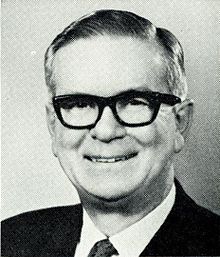
I prefer the quote “Don’t confuse me with the facts. I’ve made up my mind” but “Don’t confuse me with the facts. I’ve got a closed mind” is the original.
His quote is famous and he is remembered unfavourably for this famous line at the Watergate hearings.
Don’t Confuse Me With The Facts: The Story of Earl Landgrebe and Watergate
In the summer of 1974, the United States was in the midst of a political scandal that would shake the nation to its core. The Watergate scandal, which began with a break-in at the Democratic National Committee headquarters in Washington, D.C., had led to the resignation of President Richard Nixon. As the scandal unfolded, members of Congress were called upon to investigate the matter and determine whether Nixon had committed any impeachable offences. One of those members was Earl Landgrebe, a Republican congressman from Indiana. During the hearings, Landgrebe made a statement that would become infamous: “Don’t confuse me with the facts. I’ve got a closed mind.”.
The Watergate Scandal
Before we delve into the story of Earl Landgrebe, it is important to understand the context of the Watergate scandal. In 1972, a group of men broke into the Democratic National Committee headquarters at the Watergate complex in Washington, D.C. The men were caught and arrested, but it soon became clear that the break-in was just the tip of the iceberg. It was discovered that the men were connected to the Committee to Re-elect the President (CRP), which was working to get Richard Nixon re-elected. As the investigation continued, it was revealed that the CRP had engaged in a wide range of illegal activities, including wiretapping, burglary, and sabotage. The investigation eventually led to the Oval Office, and it was discovered that Nixon had been involved in a cover-up of the CRP’s activities.
Earl Landgrebe
Earl Landgrebe was born in Valparaiso, Indiana, in 1916. He attended Valparaiso University and later worked as a businessman and a farmer. In 1958, he was elected to the Indiana House of Representatives, and in 1968, he was elected to the U.S. House of Representatives. Landgrebe was a conservative Republican who was known for his support of Nixon. He was a member of the House Judiciary Committee, which was responsible for investigating the Watergate scandal.
The Hearings
The Watergate hearings began in May 1973 and continued for more than a year. The hearings were televised, and millions of Americans tuned in to watch. The hearings were conducted by the Senate Watergate Committee and the House Judiciary Committee. The purpose of the hearings was to determine whether Nixon had committed any impeachable offences and whether he should be removed from office.
During the hearings, Earl Landgrebe was a staunch defender of Nixon. He believed that the president was innocent and that the investigation was a witch hunt. Landgrebe was known for his combative style and his tendency to dismiss evidence that did not support his position. It was during one of these exchanges that Landgrebe made his infamous statement: “Don’t confuse me with the facts. I’ve got a closed mind.”
The Fallout
Landgrebe’s statement was widely reported in the media, and it quickly became a symbol of the Republican Party’s refusal to acknowledge the seriousness of the Watergate scandal. The statement was seen as evidence that many Republicans were more concerned with protecting Nixon than with upholding the rule of law. Landgrebe’s statement was also seen as evidence of the growing partisan divide in American politics.
In the end, Nixon resigned from office on August 8, 1974, after it became clear that he would be impeached and removed from office. The Watergate scandal had a profound impact on American politics, and it led to a number of reforms designed to prevent similar abuses of power in the future.
The Legacy of Earl Landgrebe
Earl Landgrebe continued to serve in the House of Representatives until 1975, when he was defeated in a primary election. He returned to Indiana and resumed his business career. He died in 1986 at the age of 70.
Landgrebe’s legacy is a complicated one. On the one hand, he was a loyal supporter of Nixon who believed that the president was innocent. On the other hand, his statement “Don’t confuse me with the facts. I’ve got a closed mind” has become a symbol of the dangers of political partisanship and the importance of maintaining an open mind in the face of new evidence.
Conclusion
The story of Earl Landgrebe and the Watergate scandal is a cautionary tale about the dangers of political partisanship and the importance of maintaining an open mind in the face of new evidence. Landgrebe’s statement “Don’t confuse me with the facts. I’ve got a closed mind” has become a symbol of the Republican Party’s refusal to acknowledge the seriousness of the Watergate scandal. The fallout from the scandal led to a number of reforms designed to prevent similar abuses of power in the future. Earl Landgrebe may have been a loyal supporter of Nixon, but his legacy is a reminder that blind loyalty to a political leader can have serious consequences.
