
This, then, is held to be the duty of the man of Wealth: First, to set an example of modest, unostentatious living, shunning display or extravagance; to provide moderately for the legitimate wants of those dependent upon him; and after doing so to consider all surplus revenues which come to him simply as trust funds, which he is called upon to administer, and strictly bound as a matter of duty to administer in the manner which, in his judgment, is best calculated to produce the most beneficial results for the community—the man of wealth thus becoming the mere agent and trustee for his poorer brethren, bringing to their service his superior wisdom, experience and ability to administer, doing for them better than they would or could do for themselves.
Andrew Carnegie
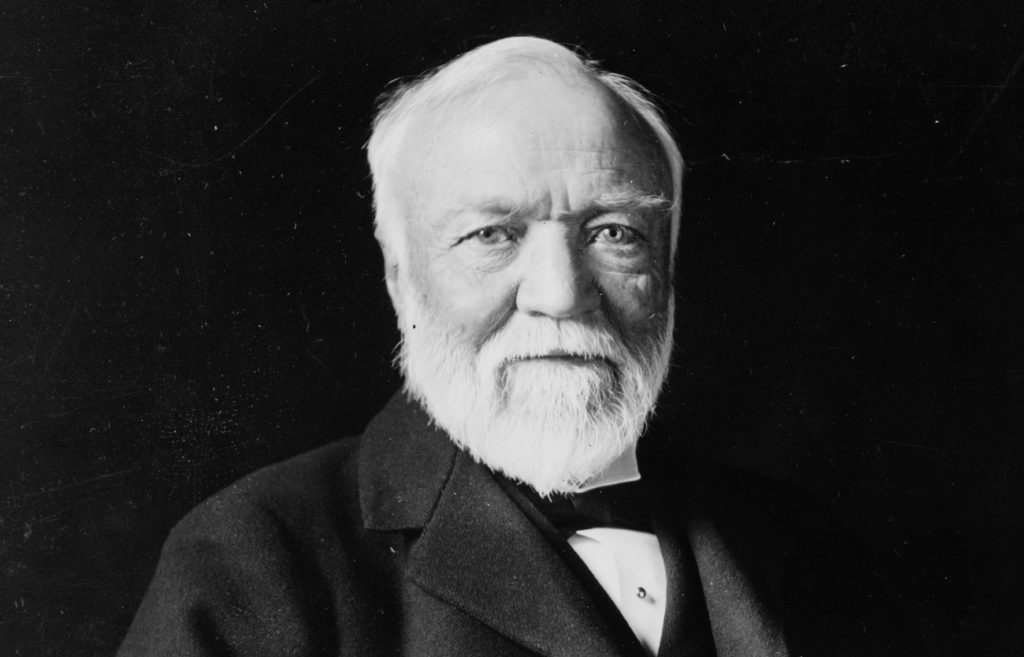
https://www.carnegie.org/about/our-history/gospelofwealth/
Today…
The Bezos backlash: Is ‘big philanthropy’ a charade? https://www.bbc.co.uk/news/business-45520594
Andrew Carnegie: The Man Who Built America
Andrew Carnegie was one of the most influential and wealthy men of his time. Born in Scotland in 1835, he immigrated to the United States as a child and eventually became a titan of industry, making his fortune in the steel industry. But Carnegie was more than just a successful businessman. He was also a philanthropist, using his wealth to fund libraries, universities, and other institutions that would benefit society as a whole. In this blog post, we will explore the life and legacy of Andrew Carnegie, examining his rise to power, his business practices, and his philanthropic endeavours.
The Early Years
Andrew Carnegie was born in Dunfermline, Scotland, on November 25, 1835. His family immigrated to the United States when he was a child, and they eventually settled in Pennsylvania. Carnegie worked his way through a series of jobs, including one as a messenger and operator at the Ohio Telegraph Company and as a secretary/telegraph operator at the Pennsylvania Railroad Company. He eventually worked his way up to superintendent of the Pittsburgh Division of Pennsylvania Railroad and caught the eye of two company executives – Thomas A. Scott and J. Edgar Thomson.
The Rise of a Titan
In 1861, Carnegie was appointed Superintendent of the Military Railways and the Union government’s telegraph lines in the East when his mentor Thomas Scott became Assistant Secretary of War. Because of his position, Carnegie had knowledge of the war machine during the Civil War and saw there was a large need for iron. He invested in iron mills and eventually built his own steel mills, becoming one of the wealthiest men in America. Carnegie’s business practices were controversial, and he was known for his aggressive tactics and his willingness to crush his competitors. But there is no denying that he was a master of his craft, and his innovations in the steel industry helped to transform the American economy.
The Gospel of Wealth
Carnegie was not content to simply accumulate wealth. He believed that it was his duty to use his wealth to benefit society as a whole. In 1889, he wrote an essay called “The Gospel of Wealth,” in which he argued that the wealthy had a responsibility to use their wealth to improve the lives of others. He believed that the accumulation of wealth was not an end in itself, but rather a means to an end. The end, he argued, was the betterment of society.
Philanthropy
Carnegie put his beliefs into action, using his wealth to fund a wide range of philanthropic endeavours. He funded the construction of more than 2,500 public libraries, believing that access to knowledge was essential for the betterment of society. He also funded the construction of Carnegie Hall, a world-renowned concert venue in New York City. In addition to his support for the arts and education, Carnegie also funded scientific research and medical facilities.
The Legacy of Andrew Carnegie
Andrew Carnegie died in 1919, leaving behind a legacy that is still felt today. His innovations in the steel industry helped to transform the American economy, and his philanthropic endeavours helped to improve the lives of countless people. Carnegie’s belief in the power of knowledge and education is still reflected in the many libraries and universities that bear his name. And his belief in the responsibility of the wealthy to give back to society is still an important part of the conversation around wealth and philanthropy.
Conclusion
Andrew Carnegie was a complex figure, a man who was both a titan of industry and a philanthropist. His rise to power was marked by controversy, but his innovations in the steel industry helped to transform the American economy. And his philanthropic endeavours, particularly his support for libraries and education, helped to improve the lives of countless people. Carnegie’s legacy is still felt today, and his belief in the power of knowledge and education is as relevant now as it was in his time.
