
I have the intellectual confidence to appear stupid sometimes.
Robert Webb
BBC iplayer: https://www.bbc.co.uk/iplayer/episode/b0074fxt/that-mitchell-and-webb-look-series-1-episode-2
“I have the intellectual confidence to appear stupid sometimes.”
Robert Webb
That Mitchell and Webb Look, Series 1, Episode 2
Robert Webb, levitation and the confidence to look stupid
There are stupid questions, clever questions and, occasionally, questions which make you wonder whether a grown man has somehow reached his thirties without settling some fairly fundamental matters about gravity.
In Series 1, Episode 2 of That Mitchell and Webb Look, Robert Webb asks David Mitchell a wonderfully simple question: can people levitate?
Mitchell’s answer is essentially no. Obviously no. Very much no.
But Webb’s defence of asking the question produces a surprisingly good observation about curiosity:
“I have the intellectual confidence to appear stupid sometimes.”
It is funny because Webb has just asked whether human beings can levitate. But beneath the silliness is a genuinely sensible point about confidence, knowledge and our fear of looking foolish.
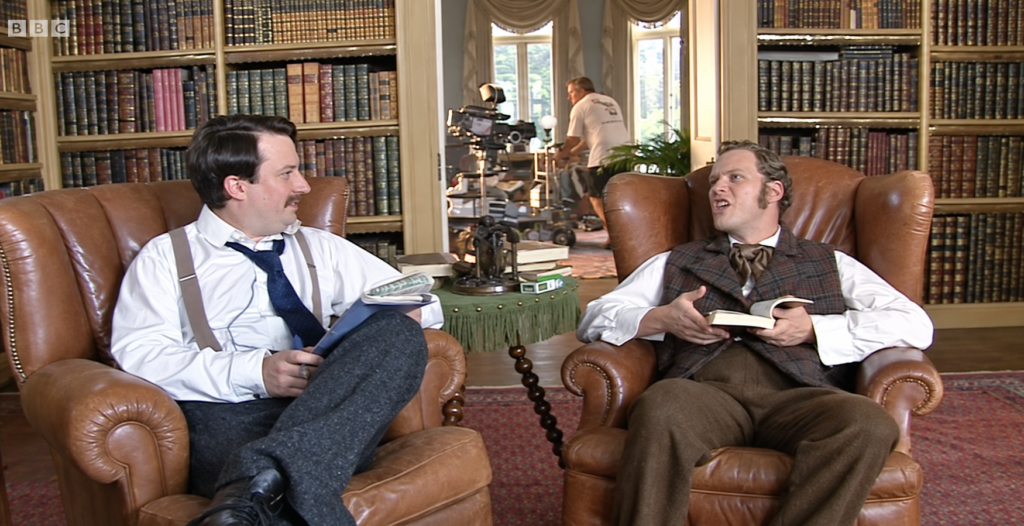
Behind the scenes, or perhaps not quite
The sketch is generally known as “Behind the Scenes: Can People Levitate?” and features Robert Webb and David Mitchell apparently playing themselves rather than fictional characters.
The joke is that viewers are supposedly seeing the comedy partnership when the cameras are not properly rolling. Webb has been reading something sufficiently convincing to make him wonder whether levitation might actually be possible. He reluctantly asks Mitchell.
He immediately knows this is dangerous territory.
Mitchell repeats the question in disbelief, and Webb becomes increasingly defensive. Mitchell then wants to know why Webb felt the need to ask something so humiliating in the first place.
That is when Webb produces his defence: he has enough intellectual confidence to risk appearing stupid.
The exchange then flips. Webb accuses Mitchell of being the one who needs to pretend he knows everything, while Mitchell admits, with characteristic pedantry, that he is sufficiently insecure to have established to his own satisfaction before the age of 33 whether human beings can fly.
The argument has therefore travelled from “can people levitate?” to a miniature battle over what intelligence actually looks like.
Why the quote is cleverer than the question
Webb’s argument is that admitting ignorance requires confidence.
If you are frightened of appearing stupid, you are more likely to pretend that you understand something. You nod along. You keep quiet. You certainly don’t raise your hand and ask whether humans might secretly possess an undocumented hovering capability.
Someone who is comfortable with their own intelligence can afford to say, “I don’t know.” They can ask an embarrassingly basic question because getting the right answer matters more than looking clever.
There is an important distinction here between being stupid and appearing stupid.
Webb isn’t claiming that asking ridiculous questions makes somebody intelligent. His argument is that intelligent people should be secure enough to expose gaps in their knowledge.
It is essentially an argument in favour of intellectual humility, delivered through a conversation about unaided human flight.
The Mitchell problem
The other half of the joke is David Mitchell.
Mitchell’s comic persona is particularly well suited to being Webb’s opponent because his response isn’t merely “no”. He needs to establish precisely how Webb has managed to arrive at the question.
That turns a straightforward correction into an interrogation.
Webb consequently interprets Mitchell’s certainty as insecurity. In Webb’s version of events, Mitchell would rather appear knowledgeable at all times than risk exposing something he doesn’t understand.
Mitchell’s comeback makes the sketch even better because he effectively admits the accusation while turning it back on Webb. He has already made sure he knows people cannot fly precisely because he doesn’t want to find himself asking about it at 33.
So both men claim intellectual victory while simultaneously admitting to different varieties of insecurity.
That is very Mitchell and Webb.
Why “I have the intellectual confidence to appear stupid sometimes” works
The line works particularly well because “intellectual confidence” sounds grand, academic and self-assured, while “appear stupid” immediately punctures it.
Webb is constructing an impressively sophisticated defence of having just asked an impressively unsophisticated question.
It also leaves open the possibility that his argument is entirely self-serving. Perhaps he really is demonstrating admirable intellectual curiosity. Perhaps he is desperately trying to recover some dignity after asking David Mitchell whether humans can levitate.
Probably a bit of both.
That ambiguity is what makes it such a good comedy quote. The philosophy makes sense even though the situation producing it is ridiculous.
Curiosity requires a little embarrassment
Outside the sketch, the quote describes a useful approach to learning.
Questions expose ignorance, but they also remove it. Pretending to understand something protects your reputation for a few minutes while preserving the very ignorance you’re trying to conceal.
The confident learner is therefore sometimes the person willing to ask the obvious question.
That doesn’t mean every daft question is secretly profound. Sometimes a daft question really is a daft question. But being prepared to ask one can be healthier than building an elaborate performance around knowing things you don’t actually know.
Webb’s line turns that idea into a compact paradox: looking stupid can sometimes be evidence of confidence rather than stupidity.
Who is Robert Webb?
Robert Webb is an English comedian, actor and writer born in Boston, Lincolnshire, in 1972. He studied at the University of Cambridge, where his path crossed with David Mitchell through the famous Cambridge Footlights comedy scene.
Together they became Mitchell and Webb, one of the best-known British comedy double acts of their generation.
Webb is particularly associated with Jeremy “Jez” Usborne in Peep Show, alongside Mitchell’s Mark Corrigan. Their partnership also produced the radio sketch programme That Mitchell and Webb Sound, the television adaptation That Mitchell and Webb Look, live shows and other television projects.
Their double-act chemistry often relies on a useful contrast. Mitchell frequently occupies the pedantic, anxious and excessively logical position, while Webb can play the more relaxed, impulsive or cheerfully unreasonable counterpart.
The levitation argument squeezes that dynamic into a particularly neat little package.
About That Mitchell and Webb Look
That Mitchell and Webb Look was a BBC television comedy sketch series starring David Mitchell and Robert Webb. It ran for four series between 2006 and 2010.
The programme developed material and ideas associated with their earlier BBC Radio 4 series, That Mitchell and Webb Sound. Its cast also included performers such as Olivia Colman, James Bachman and Paterson Joseph.
The show’s sketches ranged from recurring characters to parodies of television formats, advertising, history, science, workplace behaviour and everyday British awkwardness.
Series 1 alone gave us Numberwang, the drunken snooker commentators, Sir Digby Chicken Caesar and the now famous “Are we the baddies?” sketch.
And, of course, the important scientific question that generations of physicists had apparently overlooked: can Robert Webb levitate?
Which episode contains the quote?
The quote appears in Series 1, Episode 2 of That Mitchell and Webb Look, first broadcast on BBC Two on 21 September 2006.
The sketch is listed as “Behind the Scenes: Can People Levitate?”, although some episode listings describe it more simply as “Can people fly?”.
The episode contains a typically strange collection of other sketches, including Numberwang, the snooker commentators, a parody of daytime television, an evil villain having problems with needlessly ambiguous instructions, counterfeit money and a man capable of moving biscuits with his mind.
So, curiously, Webb asking whether people can levitate isn’t even the episode’s only encounter with paranormal object movement.
A rather appropriate bit of trivia
There is an extra joke hiding in the episode’s structure.
Webb is mocked for entertaining the possibility that a human being might levitate. Later in the same episode, the programme presents a sketch involving biscuit telekinesis.
Naturally, neither phenomenon has rescued humanity from the tyranny of walking across rooms to fetch things.
There is also a nice contrast between the deliberately shabby “behind the scenes” atmosphere and the actual success of the programme. The first series of That Mitchell and Webb Look went on to win the BAFTA Television Award for Comedy in 2007.
What does the Robert Webb quote mean?
“I have the intellectual confidence to appear stupid sometimes” means that genuine confidence in your intelligence allows you to admit when you don’t know something.
You don’t always need to demonstrate knowledge. You can ask basic questions, admit uncertainty, change your mind or risk momentarily looking foolish.
That makes the quote more than a funny defence of an absurd question. It is a surprisingly tidy statement about curiosity, humility and learning.
Although it probably shouldn’t be interpreted as evidence that people can levitate.
