
National Lampoons Vacation – Metallic Pea – Quote
You didn’t order the metallic pea?
Ed, the car salesman
Eugene Levy: Car Salesman – https://www.imdb.com/title/tt0085995/characters/nm0506405
The Quote in context
Rusty Griswold: Dad, this is not the car you ordered!
Clark Griswald: Settle down Russ. Let me handle this. Ed, uh… this is not the car I ordered. I distinctly ordered the Antarctic Blue Super Sports Wagon with the C.B. and optional rally fun pack.
Ed, the car salesman: You didn’t order the Metallic Pea?
Clark Griswald: Metallic Pea? No, Antarctic Blue!

The Significance of Metallic Pea in National Lampoon’s Vacation
Released in 1983, National Lampoon’s Vacation is a classic American comedy film that has stood the test of time. The film follows the Griswold family as they embark on a cross-country road trip to visit a theme park, encountering a series of mishaps and misadventures along the way. One of the most memorable scenes in the film is when Clark Griswold, played by Chevy Chase, goes to buy a car for the trip and describes the colour he wants as “Metallic Pea.” Let’s take a closer look at the significance of this scene.
The Scene
Clark goes to a car dealership with his family to pick up a car that he ordered for their cross-country road trip. When Ed the salesman shows Clark the car, Rusty points out to his father that this is not the car they ordered. Clark explains to Ed that he ordered the Antarctic Blue Super Sports Wagon with the C.B. and optional rally fun pack. Ed questions this by saying “You didn’t order the Metallic Pea?” simplifying Clark’s complaint to just the colour of the car. Metallic Pea is funny because it’s a ridiculous colour as we will discuss later.
The Significance
The scene is a perfect example of Clark’s character: a well-meaning, but somewhat clueless family man who is determined to make everything perfect for his family. By choosing the colour “Metallic Pea,” Clark is trying to make a statement about the car’s quality, but he doesn’t really know what he’s talking about. The colour itself is also significant because it’s an unusual colour for a car, and it’s not one that would typically be associated with luxury or high-end vehicles.
However, the scene has become iconic in popular culture and has been referenced in numerous other movies and TV shows. The phrase “Metallic Pea” has become synonymous with the film and is often used to describe anything that is outdated, tacky, or uncool.
The Legacy
National Lampoon’s Vacation has become a beloved classic, and the scene where Clark describes the colour “Metallic Pea” has become one of the most memorable moments in the film. It’s a perfect example of the film’s humour and its ability to find the absurdity in everyday situations. The scene has become so iconic that it’s hard to imagine the film without it, and it continues to be referenced and celebrated by fans of the movie.
Conclusion
The scene in National Lampoon’s Vacation where Clark Griswold describes the colour of his car as “Metallic Pea” is a perfect example of the film’s humour and its ability to find the absurdity in everyday situations. The scene has become an iconic moment in popular culture and continues to be celebrated by fans of the film. It’s a reminder that even the smallest details can have a lasting impact on the legacy of a film or a cultural phenomenon.
About National Lampoon’s Vacation
“National Lampoon’s Vacation” is a 1983 American comedy film directed by Harold Ramis and written by John Hughes. The film follows the Griswold family’s cross-country road trip from Chicago to the fictional amusement park, Walley World in California. The movie stars Chevy Chase as Clark Griswold, a bumbling yet lovable father who wants to give his family the perfect vacation.
The movie’s plot revolves around Clark’s determination to provide his family with a memorable summer vacation by taking them on a road trip to Walley World. The journey is full of misadventures and challenges, including getting lost in the desert, staying in a seedy motel, and having their car stolen. Despite these obstacles, the family perseveres, and they eventually arrive at Walley World, only to find that the park is closed for repairs.
The film’s other characters include Ellen Griswold, played by Beverly D’Angelo, Clark’s long-suffering wife who tries to keep the peace between her husband and their children, Rusty and Audrey, played by Anthony Michael Hall and Dana Barron, respectively. The family encounters a variety of colourful characters along the way, including a flirtatious model, a redneck cousin, and a mysterious woman in a Ferrari.
“National Lampoon’s Vacation” is a hilarious and heartwarming film that has become a beloved classic. The movie is full of memorable moments, from Clark’s attempts to bond with his son on the road trip to his hilarious tirade when he discovers that Walley World is closed. The movie’s themes of family, perseverance, and the importance of taking time off to enjoy life still resonate with audiences today.
The Wagon Queen Family Truckster
In the original National Lampoon’s Vacation film, the car prominently featured is known as the “Family Truckster.” This iconic vehicle was created as a satirical representation of the quintessential American family station wagon. Designed by the film’s production team, the Family Truckster is a fictional and exaggerated version of the Ford LTD Country Squire, a popular station wagon model at the time.
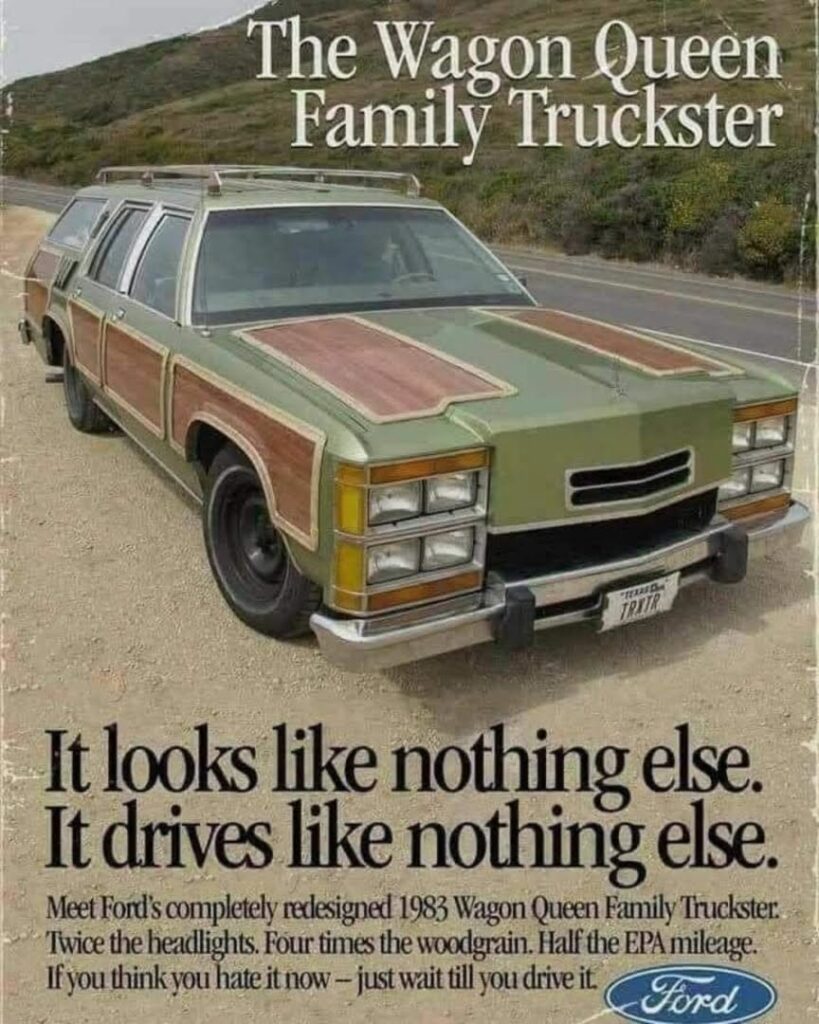
The purpose of the Family Truckster was to serve as a comedic element, adding to the overall humorous tone of the movie. It was deliberately designed to be excessively large, unattractive, and adorned with various peculiar features. The exaggerated design elements included a monstrous size, fake wood panelling, an unconventional paint scheme, and an assortment of bizarre accessories.
The exterior of the car featured an eye-catching metallic pea-green colour, accompanied by wood-grain side panelling that was prevalent in many station wagons of the era. The body was elongated and boxy, further accentuating the exaggerated dimensions of the vehicle. The overall appearance was intentionally over-the-top, reflecting the film’s satirical take on the concept of a typical family car.
Throughout the movie, the Family Truckster became a symbol of the Griswold family’s misadventures and served as a source of comic relief. It faced numerous comical mishaps, including running out of fuel, enduring mechanical failures, and becoming involved in humorous accidents.
The portrayal of the Family Truckster in National Lampoon’s Vacation became an enduring and iconic aspect of the film. Its outlandish design and comedic role in the movie have made it a memorable part of popular culture, often referenced in relation to the Vacation film series as a whole.
Overall, the Family Truckster was a fictional creation, specifically designed to mock and exaggerate the characteristics of American family station wagons from the time period. Its distinctive appearance and role in the film have solidified its status as a beloved and recognizable cinematic vehicle.
Is the Family Truckster a real car?
The Wagon Queen Family Truckster, an abomination of automotive design, was never a Ford production car. It was the brainchild of the Kustom Kar King himself, George Barris, who conjured it up exclusively for the movie. Taking a 1979 Ford LTD Country Squire wagon as his canvas, Barris unleashed his creative madness. He swathed it in copious amounts of faux wood panelling, adorned it with a repulsive Metallic Pea paint job, and inexplicably doubled the number of headlights.
The result was a breathtakingly hideous car that proved to be the perfect chariot for the moronic yet well-meaning Clark Griswold. Even Clark himself despised the car, but it was the low-level schlub extraordinaire, Eugene Levy, who convincingly persuaded him otherwise. “This is a damn fine automobile, if you want my honest opinion… You think you hate it now, but wait until you drive it.” And so, the wretched Family Truckster embarked on its journey, forever etching its ghastly presence in the annals of cinematic automobiles.
the Family Truckster is a Ford LTD Country Squire
The production team started with a base chassis from a Ford LTD Country Squire, a popular station wagon model of the time. However, they heavily modified the vehicle to match the vision they had for the Family Truckster. The modifications included elongating the body of the car to enhance its overall size and boxy appearance, creating a more exaggerated silhouette.
To give the Family Truckster its distinct look, the production team added a variety of unique and humorous design elements. They used fibreglass moulds to create exaggerated fender flares, giving the car a more pronounced and unconventional shape. The iconic metallic pea-green colour was chosen to further enhance the car’s unattractive and garish appearance.
In addition to the body modifications, the production team adorned the car with faux wood-grain panelling, mimicking the popular wood-trim style found on many station wagons of the era. The team also incorporated quirky accessories such as an oversized luggage rack on the roof, extra headlights, and other humorous embellishments to enhance the comedic effect.
By customizing and augmenting the Ford LTD Country Squire, the production team successfully transformed it into the fictional Family Truckster, a larger-than-life parody of the traditional family station wagon. The exaggerated features and unique design choices contributed to the comedic nature of the vehicle, making it an integral part of the film’s visual humour.
It’s worth noting that while the Family Truckster was created specifically for National Lampoon’s Vacation, there have been replicas and homages to the car made by enthusiasts and fans of the film over the years. These replicas often involve modifying existing station wagons to resemble the iconic vehicle from the movie, showcasing the enduring popularity and cultural impact of the Family Truckster.
George Barris – the “King of Kustomizers”
George Barris, known as the “King of Kustomizers,” was a prominent figure in the world of custom car design. Born on November 20, 1925, Barris gained fame for his innovative and extravagant automotive creations, often seen in movies, TV shows, and popular culture.
Throughout his prolific career, Barris was involved in designing and modifying numerous iconic vehicles. He had a keen eye for transforming ordinary cars into extraordinary, attention-grabbing works of art. His imaginative and flamboyant designs captured the spirit of the times and left a lasting impact on automotive and pop culture enthusiasts.
One of Barris’s most renowned creations was the Batmobile for the 1966 Batman television series. Designed in just three weeks, the Batmobile became an instant sensation, solidifying Barris’s reputation as a master customizer. He also worked on other famous TV show vehicles, such as the Munster Koach from The Munsters and the Black Beauty from The Green Hornet.
Barris’s designs were not limited to the small screen. He crafted unique custom cars for numerous celebrities, including Elvis Presley, Frank Sinatra, and John Wayne. His creations often featured extravagant modifications, futuristic styling, and eye-catching details, making them stand out in any crowd.
As a successful entrepreneur, Barris founded Barris Kustom Industries in North Hollywood, California. His shop became a hub for automotive enthusiasts and a gathering place for the custom car community. Over the years, Barris and his team continued to create one-of-a-kind vehicles for clients and various promotional events.
George Barris’s impact on the custom car industry cannot be overstated. He played a pivotal role in popularizing custom car design, pushing the boundaries of creativity and innovation. His imaginative works inspired generations of car enthusiasts, propelling the custom car scene into the mainstream and forever leaving an indelible mark on automotive history.
George Barris passed away on November 5, 2015, leaving behind a rich legacy of automotive artistry and a body of work that continues to captivate and inspire car enthusiasts worldwide.
Metallic Car Paint
Metallic car paint is a type of automotive paint that contains small metallic flakes or particles within the paint mixture. These metallic particles give the paint a shiny, reflective appearance and create a unique sparkling effect when light hits the surface of the car.
The metallic flakes in the paint are typically made of aluminium or other metals, such as bronze or copper. These flakes are suspended in a clear coat or base coat, which is then applied to the car’s body panels. The clear coat provides a protective layer and enhances the paint’s glossiness.
The size and distribution of the metallic flakes in the paint determine the final look of the finish. Larger flakes tend to create a more pronounced sparkle, while smaller flakes can give a smoother, more subtle effect. The colour of the metallic paint is usually determined by the base coat, which is tinted with pigments.
Metallic car paint is popular for its ability to create a vibrant and dynamic appearance. It can enhance the curves and lines of a car’s body, making it more visually appealing. However, it can also be more challenging to repair and match if the paint gets damaged, as the metallic flakes can make colour matching more difficult.
To maintain the appearance of metallic car paint, regular washing and proper care is necessary. This includes avoiding abrasive cleaners or materials that can scratch the surface and using car waxes or sealants designed specifically for metallic finishes.
Paint Colour Names
Paint colour names are typically chosen by the manufacturers or companies that produce and market the paint. The process of naming paint colours can vary between manufacturers, but it often involves a combination of creativity, market research, and branding considerations. Here are some common factors that influence the selection of paint colour names:
- Descriptive Qualities: Paint colour names often reflect the visual characteristics or attributes of the colour. Descriptive names like “Sapphire Blue,” “Warm Beige,” or “Vibrant Red” help customers understand the general appearance of the colour.
- Associations and Emotions: Colors can evoke certain emotions or have cultural associations. Paint colour names may be chosen to tap into these associations, such as “Serenity,” “Harmony,” or “Passion Red,” to create an emotional connection with the consumer.
- Inspiration: Paint colour names can be inspired by various sources, such as nature (“Meadow Green”), geography (“Tuscan Sunset”), or historical references (“Victorian Rose”). They may also draw inspiration from trends, fashion, art, or popular culture.
- Branding and Marketing: Paint manufacturers often use colour names as a way to reinforce their brand identity and differentiate themselves from competitors. Consistent naming conventions or themes across a product line can help establish brand recognition and loyalty.
- Market Research: Paint companies may conduct market research to understand consumer preferences and trends. This research may include surveys, focus groups, or analysis of industry data. The findings can influence colour naming decisions to align with customer preferences and market demands.
- Cultural Considerations: Paint companies often cater to global markets, and colour names may need to be culturally sensitive and appropriate in different regions. Translations or adaptations of colour names may be necessary to ensure they resonate with local audiences.
It’s important to note that while some paint colour names are straightforward and descriptive, others may be more abstract or imaginative, such as ‘Metallic Pea’. The goal is to create an appealing and memorable name that captures the essence of the colour and resonates with customers. Metallic Pea may just be the most memorable paint colour name ever conceived.
The National Lampoon film series
The National Lampoon film series consists of several movies, including the Vacation series and other films not sponsored by National Lampoon
A list of the National Lampoon’s Vacation movies in order of release, along with their cast members:
National Lampoon’s Vacation (1983)
Cast: Chevy Chase, Beverly D’Angelo, Anthony Michael Hall, Dana Barron
National Lampoon’s European Vacation (1985)
Cast: Chevy Chase, Beverly D’Angelo, Dana Hill, Jason Lively
National Lampoon’s Christmas Vacation (1989)
Cast: Chevy Chase, Beverly D’Angelo, Juliette Lewis, Johnny Galecki
Vegas Vacation (1997)
Cast: Chevy Chase, Beverly D’Angelo, Randy Quaid, Ethan Embry
Christmas Vacation 2: Cousin Eddie’s Island Adventure (2003)
Cast: Randy Quaid, Miriam Flynn, Dana Barron, Jake Thomas
Vacation (2015)
Cast: Ed Helms, Christina Applegate, Skyler Gisondo, Steele Stebbins
